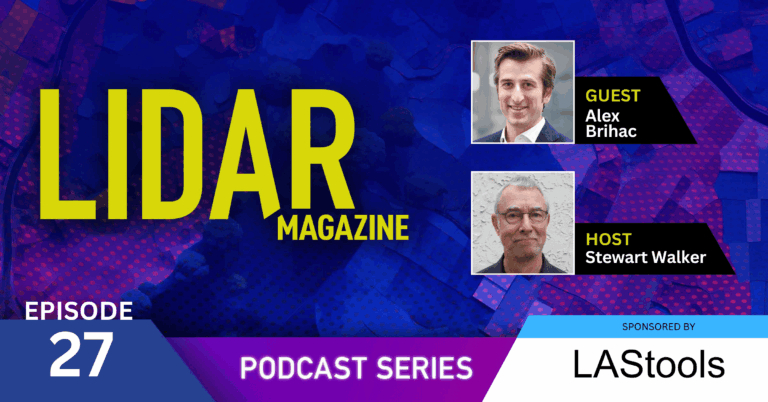
Alex Brihac is Vice President, Head of Strategy and M&A at Hexagon Geosystems. He explains how his interest in engineering was imbued by his Romanian parents, resulting in his choices of undergraduate and graduate studies. His work for Turner Construction and McKinsey led to expertise in improving firms’ performance as well as a deep interest in digital twins and how they should be created and used. He provides insights into the strategy development process at Hexagon and the way the company manages the acquisition process. He stresses technology – Hexagon spends more than 15% of annual revenue on R&D – and the tremendous importance of talking to customers. Finally, he briefly covers the Octave spin-off and some of the directions Hexagon will take in 2026 and beyond.


Episode Transcript
#27 – Alex Brihac
January 6th, 2026
{Music}
Announcer (00:01.998)
Announcer: Welcome to the LIDAR Magazine Podcast, bringing measurement, positioning and imaging technologies to light. This event was made possible thanks to the generous support of rapidlasso, producer of the LAStools software suite.
Announcer (00:02)
Welcome to the LIDAR Magazine Podcast, bringing measurement, positioning and imaging technologies to light. This event was made possible thanks to the generous support of rapidlasso, producer of the LAStools Software Suite.
Stewart Walker (00:26)
Welcome to LIDAR Magazine and the LIDAR Magazine podcast series. My name is Stewart Walker. I’m the managing editor of LIDAR Magazine. My guest today is Alex Brihac, vice president, head of strategy in M&A, Hexagon Geosystems. Alex, we’re delighted to have you on board and it’s a great pleasure to be talking to you. It was a wee bit challenging to schedule this podcast.
And LIDAR magazine is very grateful to you for finding the time. I also want to say just a quick word of thanks to your colleagues in Hexagon in Switzerland and to the people in TFD, the PR company in London for helping set this up.
Alex Brihac (01:07)
Stewart, very happy to be here. I’m very excited we could find the time as well.
Stewart Walker (01:11)
Well, let me set the scene very quickly. You’re in a very senior position with Hexagon Geosystems. And of course our listeners are very familiar indeed with that organization. Now you’ve got a strong engineering background, but your position is very much a business management ⁓ one. And that, that really makes this podcast a little bit different from earlier ones. And I’ve been really looking forward to the conversation. So, so let’s jump in.
I want to clarify something at the very beginning to make sure I don’t screw up later on. Your job title starts with vice president, head of strategy and M&A Hexagon. So I just wanted to make sure, do you work at the corporate level or in the Geosystems division, which is one, I guess, one of the six sides of the Hexagon. I know you work in the AEC segment.
Alex Brihac (02:02)
So thanks for clarifying, Stewart. I work within Geosystems, so not at corporate level. As you all know, and a lot of your listeners might know as well, we have a spinoff at the moment, which is progress called Octave. And, after the spinoff, you’re more or less going to have three big business areas within Hexagon. One is called manufacturing intelligence. One is called Geosystems, which is the one that I represent on this podcast now.
And then the third one is autonomous solutions. And then we have some smaller divisions like one robotics, but there’s going to be three major business areas. And I run the strategy and M&A for Geosystems. Now, of course, I coordinate at corporate level, as you can imagine, with the corporate team. I coordinate with my peers in manufacturing intelligence and autonomous solutions on various M&A targets and so and so forth. But to answer your question, I’m very much focused on the geosystem strategy and M&A.
Stewart Walker (03:00)
There are no plans to rename the company Triangle.
Alex Brihac (03:04)
No, the allusion to what we do is quite strong. And actually, we might get you on the marketing team, Stewart, but no, we’re going to keep it as Hexagon.
Stewart Walker (03:15)
Now you’re located in the Geneva area, you’re not in Zug and you’re not in Heerbrugg.
Alex Brihac (03:21)
That’s And that’s mostly for personal reasons. We moved to Switzerland from the U.S. about four, almost five years ago. And we set home in Geneva. But as you can imagine, Switzerland is not a very big country. So you’ll find me almost on a weekly basis in either Zug or Heerbrugg. Also thanks to the Swiss train systems, which make it very comfortable for my home to get basically anywhere in the country, but especially to the Hexagon offices in Heerbrugg, which is in East Switzerland for those who don’t know, close to the border with Austria.
Stewart Walker (03:51)
Yes, I’m happy to say I’ve been there many times. It’s a beautiful place. So now that we’ve clarified that, let’s start. I always like to learn a little bit about my, my guests before we get into matters, technical or, business. Tell us something about yourself, your early life.
Alex Brihac (04:09)
On the personal side, I’m actually European born. My parents come from Romania. They’re both engineers. My mom is a chemical engineer. My dad’s a hydraulic engineer. So, you know, I was very much raised with, you know, what in the US, of course, we, you you guys call a lot sort of the immigrant mentality, which is sometimes with my friends who also come from certain regions, you know, our parents were very much like, you can do whatever you want to do in life after you become an engineer, a doctor or a lawyer type of thing, you know?
So of course, growing up in a family of engineers, I got interested in engineering quite early. Actually, mostly I got interested in architecture. So ending up working for a technology company, it’s a bit of an unnatural path for me because my whole life I grew up thinking I’m going to design houses, build buildings and stuff like that.
But then I got a scholarship at a university in the U.S. but that university at the time didn’t have an accredited architectural program. And then I went into civil engineering because, know, like most of us, think that civil engineering is just architecture with bit more numbers, which is not, you know, which is not fully true, but also not entirely untrue. And it served me well because then for about a decade after university, I spent it with a company that’s probably familiar to some of your listeners called Turner Construction in the U.S., mostly in the Northeast, so Philadelphia, Pittsburgh, New York, where I worked more or less across the project lifecycle. So I spent a couple of years in the field as a field engineer, literally pouring concrete and overseeing crews.
Then I spent a couple of years in the office where I worked in procurement, in estimating very much next to architects, next to real estate developers early in the design phase for them to understand what’s the cost, what’s the schedule of whatever is the option of the building they plan to build. And then I spent the last couple of years before I moved out of the construction sector in the field again, this time at a more manager level on a very cool project in New York called the Rockefeller University Building, which is basically a building that’s four blocks long on top of the FDR drive in New York City.
So, but I guess what I’m trying to say is I was never a technology first type of person. You know, my friends would probably like to joke that I’m always the type of guy that if something happens to my computer, I unplug and plug again, right? It’s a computer. I’m that kind of guy. I was always a problems first and tech second. And that actually surprised me has served me quite well in the tech world ⁓ because I always ask the dumb questions that somehow end up sparking very interesting conversation of what makes business sense, what doesn’t make business sense and therefore what makes a potential technology successful, but bring it to customers. That’s a little bit about me, I guess a little bit more than probably what you were hoping for.
Stewart Walker (07:12)
Well, it does answer some of the questions and it answers, example, why in this phase of your life, found yourself in a very geospatial area. I’ve just got one question about those early years after your bachelor’s at Lehigh, you did a master’s in construction engineering at Cambridge. suppose we tend in our minds to associate Cambridge with more esoteric fields, philosophy over hundreds of years, leading edge medicine.
So why did you choose Cambridge for engineering? And indeed, why didn’t you do an MBA?
Alex Brihac (07:46)
First of let me start with why I didn’t do an MBA. When I joined the industry, I joined the industry with the same sort of view like most people who go into construction, which is, I want to build the longest bridge, the tallest skyscraper over a 40 year career. I mean, that’s how I approach at least my life at the time. So therefore an MBA, when you’re 23 young engineer just doesn’t quite make sense.
Instead, what you want to do is to just get better at building stuff. So therefore, my path at the time, the way it was planned was to get a master’s in either structural engineering to become more familiar with the structures that I’m building or construction engineering or construction management, like it’s called in the US, which is to be better at how I plan to build the building.
I naturally I applied to some of the top schools in the U.S. like Columbia University. And then I found out that Cambridge University also has actually quite, I mean, a very strong civil engineering department. They had a very cool program called Construction Engineering Masters, which basically is the Department of Construction Management. And I decided to go with Cambridge simply because Lehigh University, while it’s very familiar in the U.S., especially for those who go into engineering fields.
It’s not basically an international household name. So if I ever wanted to go build something in Asia or Europe, and I wanted my CV to somehow be a bit more attractive to a future employer, I just wanted to have a name that’s more recognizable outside of the US as well. So that was kind of the reasons. And then also my family moved back to Germany. I wanted to also be a bit closer to my family. And then basically I spent a couple of years actually going to Cambridge and getting a master’s degree.
Stewart Walker (09:37)
Turner, then you spent six years with McKinsey. And I guess we think of that as, suppose, the primus inter paris of the big consultancies. You reached associate partner, huge achievement. So most of our listeners will have heard of McKinsey, but it’s maybe worth saying that its alumni include the CEOs of Alphabet, Morgan Stanley, Vodafone, Lego, Levi Strauss, and there are lots of others. And a little while back, I had as my guest on this podcast, Dr. Felix Reinshagen, he’s CEO and co-founder of NavVis, which makes handheld laser scanners. You’ve probably met him. So I’m interested in this and your focus, and I’m quoting your LinkedIn profile here. Your focus in McKinsey was driving capex optimization and tech adoption in the construction, infrastructure and real estate industries. So tell us why you chose that path and a little bit more about what you did at McKinsey.
Alex Brihac (10:36)
It’s kind of funny, I actually never met Felix in person, although as you can imagine, we’re in constant touch with NavVis but ending at McKinsey was a little bit of an accident with a personal twist, if I can say so. So after I graduated Cambridge, McKinsey approached me. Unfortunately, being in the construction industry, I didn’t quite know much about management consulting. To be honest, back then when I heard McKinsey, I knew, okay, something with Wall Street, CEOs, but I don’t know exactly what they do.
The consultancies that I was familiar back then is what we define consultancies in the construction industry, which is like geotechnical consultants, structural consultants, like the Arabs of the world, the Thornton Tomasettis of the world. But then shortly afterwards, my wife was actually a medical doctor, got also approached by McKinsey because McKinsey at the time was also realizing that having consultants with an MBA background only can only bring so much value to one of their clients.
What they need to do is to have more expertise on top of the typical consulting toolkit that a consultant brings to a customer. basically, together with my wife, we both applied thinking that we’ll never get the job because if we read every single blog, you basically realize that it’s super competitive. You compete against people who come from very strong MBA programs. But eventually both applied and we both got the job.
And then we were like, well, let’s try it for a year and see how it goes. Hence why it was a bit of an accident with a personal twist. But then once I joined McKinsey, I realized that actually what they do is extremely interesting, extremely analytical work. So basically, McKinsey serves a wide range of customers from industrial manufacturers to real estate developers to government agencies. And a lot of these clients have very capex heavy programs. So if I’m an oil and gas company, I have billions and billions of dollars in assets, which I need to maintain, I need to expand, I need to build new refineries, I need to build pipelines. If I’m a DOT, same with highways and bridges, if I’m a real estate developer, same with a portfolio of buildings.
And so on so forth. Basically, what McKinsey did, well, still does today, is they help a customer think through the entire project life cycle, including the portfolio management. So from questions of what projects should I even build to how should I build them to what’s the most efficient way to contract them to the market? Because you have many types of construction contracts out there.
to ⁓ what technology can I use to build them in order to basically have transparency to schedule costs and so and so forth. And that’s where my background kind of fit perfectly in. then when I joined McKinsey, they basically put me in what’s called a mini MBA program because I was the kind of guy who didn’t even know the difference between a balance sheet and an income statement. So I learned, I got an MBA crash course and then afterwards, I got the same sort of training like every McKinsey consultant.
So what I ended up doing is I worked for exactly these type of customers. I worked together with some government agencies. I worked with real estate developers. I worked with mining companies. I worked with energy companies, mostly on understanding what projects they should invest in. Because believe it or not, if you’re an oil and gas company and you have a refinery,
On that refinery alone, you’re probably going to have anywhere between 100 and 200 projects per year. Everything from like small maintenance projects to a billion dollar extension, for example. And you need a way to prioritize these projects for safety reasons, for economical reasons, all the way to actually optimizing the projects themselves. So if a project would cost say a billion dollars on paper, can you achieve the same output for that project, for that asset with a 30 % cost reduction.
And I guess the reason why I’m providing this context is this is also a good leeway a little bit into how I got to play a little bit with technology. ⁓ So I worked with what we call green capex clients, so battery manufacturers, green steel manufacturers. And the economies of having a successful battery manufacturing business, for example, is try to get the cost of these Gigafactories down as aggressively as possible.
So, you know, kind of like the famous Tesla model, like, you know, Gigafactory number one is X amount of dollars per gigawatt hour. Gigafactory number two has to be 50 % cheaper. Gigafactory number three has to be 70 % cheaper per gigawatt hour. So, these super aggressive cost curves. And what we realize is that you’ll never get these aggressive cost curves down if you just play with specifications, right?
You need to have a more holistic approach and therefore start to optimize the project early into the design stage. And that’s how we started playing with Digital Twins. Now, Digital Twins was not some fancy 3D model that looks good on a screen. The way we thought about Digital Twins back then is how do you model the production line of a Gigafactory; how do you model the inventory area of a such that the throughput of the factory is the same, but the surface area of the factory is like 30, 40 % smaller. And that was actually quite successful. And that’s how I learned about digital twins. That’s how I got into the world of construction technologies.
Stewart Walker (16:30)
Wow, it is indeed fascinating. After that, you joined Hexagon August 2023. Has that change given you satisfaction? Has it been a good career move?
Alex Brihac (16:43)
Absolutely. I mean, if you take the world of AI, the world of data today, which arguably some people might say are the two most exciting ⁓ fields to be in today, Hexagon is at the center of those both because we captured that in the field. So therefore we produce a lot of geospatial data. But then we also work with partners or ourselves on bringing these data to life across certain workflows. And of course, AI now comes into play.
Stewart Walker (17:15)
Right. And now for a word from our sponsor, LAStools.
—
The LIDAR Magazine Podcast is brought to you by rapidlasso. Our LAStools software suite offers the fastest and most memory efficient solution for batch-scripted multi-core lidar processing. Watch as we turn billions of lidar points into useful products at blazing speeds with impossibly low memory requirements. For seamless processing of the largest datasets, we also offer our BLAST extension. Visit rapidlasso.de for details.
—
Stewart Walker (17:53)
So Alex, we know you a whole lot better now. So let’s talk about your current work. You’re involved in both strategy and M&A. So let’s start with strategy. And I have to say on my MBA, I got a B in strategy. So it wasn’t an easy relationship. But tell me how Hexagon forms its strategy, which is presumably a continuous work in progress. Do you have different strategies at corporate and divisional, market segment level? How does it work?
Alex Brihac (18:23)
In short, I would say if I were to take a strategy exam right now, I’d be lucky if I get a B. Strategy is not an easy thing. So let me walk you through how strategy works at Hexagon. At Hexagon right now, there’s a corporate layer, which is Hexagon. Then there’s business areas, manufacturing intelligence, Geosystems, and autonomous solutions. And then each one of the business areas has divisions.
So for example, some of our divisions in Geosystems are geomatics, where people associated with surveying total stations, GNSS, machine control is another division, radar and monitoring is another division. And what you want to do is not to have different strategies, but to have a consistent strategy across all these layers with different emphasis of that strategy, depending on what the layer is interested or focused on in terms of growth.
So within Geosystems, what I try to do is number one, understand from the various divisions, what do they consider to be pragmatic strategies that help them with growth ⁓ in both the short and midterm and understand from them, given they’re also competitive environments, ⁓ what are some more long-term visionary strategies? Then I take that message to the Geosystems level and the geosystem level, I tried to do the same balancing act, looking at our portfolio of solutions, looking at what are our adjacent areas of growth, tried to define a north star that, you know, for Geosystems that can grow in one direction and then try to align that with each one of the divisions.
Now, my job is helped enormously by the fact that the divisions do a very good job setting their strategies and by the fact that a lot of our divisions sort of are involved in geospatial data. So therefore it is quite easy for me. what you try to do is, at least at Justin and I both, is to define what are the market segments where we want to win? What are the market segments where we might not necessarily win, but we need to play? We need to have a presence, we have some solutions for those customers because they need the full workflow. And then what are some of the market segments where we want to divest from, we want to move out, or we don’t want to have a presence at all.
So I tried to take this more macro look. And that’s more cookie cutter analysis where we look at what are the market segments, what’s the competitive landscape, how much the market segment is growing, is there a gap for the customer need, is there a gap in what the competitors are bringing, and then do we have the right to win in that? Do we have the capabilities internally in terms of R &D, terms of good marketing, in terms of product portfolio, to be able to successfully fill that gap and therefore grow into that space.
But, I rely a lot on the divisions. So this is not a word that’s happening within the world of Alex Breehawks. this, although there’s a lot of divisions don’t have strategy teams defined per se, they have people looking after various aspects of work which gets pulled together in what you might call strategy work. So if I had to put a number into the amount of people involved in defining geosystem strategy, I could easily probably say 40, 50, 60 people at a minimum, right? Because you have technology people, have finance people, you have market people. So that’s number one. And then number two, you always have to balance the customer needs the solution offerings and the capabilities you have to build those capabilities and bring them to the customers.
So it’s always a bad strategy if you want to build something that customers don’t ask for. So therefore, the first thing that I do to go with the divisions is keep a constant pulse on what our customers want. And sometimes you have customers like, you know, local surveying agencies that have very distinct needs only with robotic total stations.
But sometimes you have enterprise customers like the big engineering conglomerates, which have global coverage and their needs are much more diverse. They have servers in the field, but they also have estimators. They also have a fleet of construction equipment which needs machine control systems. So we always try to understand at both large enterprise customers as well as smaller customers, what are their needs? Then we understand, as I said, what are the offerings that we can provide. And then we understand if we have the capabilities to provide those customers with those offerings. And if those three are aligned, that gets entered into a OE System strategy.
Stewart Walker (23:17)
All right. So that strategy now talk a little bit about M and A it’s, it’s noticeable that both you Hexagon and Trimble have made hundreds of acquisitions over the last, let’s say quarter century. listened to your bricks and bites podcast that you had last year. You gave an estimate that Hexagon had made more than 160 acquisitions between 2002 and 2024.
Is that fairly typical for large companies and how do you manage all these investigations and transactions that are going on?
Alex Brihac (23:54)
So 160 acquisitions, just to clarify, is across all of hexagons and not just Geosystems. So if you think about 160 acquisitions, that is across Geosystems as well as manufacturing, the intelligence, autonomous solutions, the other business areas that I mentioned before. Now, to your question, is that first of all, typical or atypical? I would say that looking at some of the big industrial peers is not atypical, we have to realize that not all acquisitions are created equal. So a lot of the times, if you know the big industrial players out there, you might read in the news only about the biggest acquisitions they do. then one might think that, no, a big player like, don’t know, like Siemens or ourselves or others, they do only those big acquisitions.
But there’s actually a lot of other smaller acquisitions that we do, which never ends up in a, well, we’ve released it as a press release, but it might not end up in an industry magazine. So that’s the first thing to understand, not all acquisitions are created equal. Now, how do we manage these acquisitions? First of all, how do we even understand if something needs to be acquired or not? I would say there’s always a reason to acquire something if it’s cheaper and or faster than doing it organically. Now, this again has variations.
It can be a product gap or a technology gap. And then you might want to acquire just the technology. It might not even have a go to market yet. It might be a small company with three PhD students out of university that just so happened to build a really good product that we can plug and play into our bigger portfolio. So that’s an example of that. Or we could acquire a distribution channel in a new market.
So if we want to expand into a new country and we don’t find partners where we can scale rapidly with or it’s going to take us too long, it’s going to be too big of an effort for us to hire people in the market, it could be that we might just acquire a distribution partner. And that distribution company might actually be quite small if it’s in a small market, but that will still be part of the 160 acquisitions. So again, coming back to not all acquisitions are created equal, but it can also go into a large acquisition. And that’s typically where we look at new strategic growth areas.
Let’s say, for example, a couple of years back, we acquired Bricsys, which one of their flagship products is BricsCAD. Now, there’s not going to be part of Hextech we’re going for. That’s going to be spun off into a separate company called Octave. But at the time, the idea was that we want to expand back in 2018 or whenever the acquisition happened, we want to expand with design tools.
And of course there was no capability in house and therefore we had to acquire someone external and that was a more sizable acquisition that we did. The other question that you had is like, how do you manage all of the investigations across all of these transactions? Within Hexagon, are, I would probably say we’re more decentralized than other companies, but of course with the right level of responsibility and accountability across the different teams. So therefore,
When a certain division or a certain business area comes up with a proposal to acquire a company, ⁓ very quickly we can assemble a SWOT team of say two, three technology guys, two, three go-to-market experts, AI R &D experts, for example, from our AI Hub, where the M&A representative, which is me or someone from my team acts more so as the project manager of that process, relying on the expertise, the input, the hard work done by the people from the various divisions who, by the way, they don’t do this as their full-time job. Their full-time job is actually to build something else for the divisions.
But for this particular topic, they might be, they have the right expertise to provide their feedback on. So that’s how we are able to run through a large number of acquisitions because we basically have a pool of experts, which is in the hundreds that we can tap into right away, depending on the type of acquisition that we want to make. And then I think the last thing that you mentioned is how do you bring these companies into the fold? So this is where we have a post-merger integration process, which, I mean, can last ⁓ anywhere between one year to multiple years, depending how long the synergies last, where we track integration we track the success of each acquisition a bit closer after we make the acquisition.
Stewart Walker (28:43)
Yes, and we can go naturally from there to the technology input in this process. Now, you’re going to hit some candidates for acquisition, either because you’ve seen something yourself as a result of talking to customers or something purely serendipitous happens, but you need some technical expertise. Now, I’ve been happy to listen at events to your CTO, Dr. Burkhard Boeckem.
Great presentations. So you can go to people like that and say, Hey, what do you think of this company that we could consider acquiring?
Alex Brihac (29:22)
The process is a little bit more structured than that. Although I do go to Burkhard a lot and say, hey, how about this? And yeah, Burkhard, our CTO, he’s amazing. And his breadth of expertise is really mind blowing to me. But we have a bit of a more structured process ⁓ that a lot of these teams get involved a lot earlier.
You have practice process and then you have what you call like a reactive process. So the practice process is basically where ⁓ we already develop a list of potential acquisitions based on the strategic areas we want to grow. So therefore the names of the companies which we’re interested to acquire, we know them years ahead of time, maybe before we even pull the trigger on acquisition, because it’s also a matter of time.
In that instance, someone from the technology hub or someone like Burkhard, of course, will know the asset much, much in advance and he already likely has reports about how we compare in terms of technology features and so on and so forth. Then you have sometimes acquisitions which happen what I call reactive that come through to bankers. And this is where a specific company has decided they want to be acquired or a certain owner decides they want to divest the company. They hire a bank and they basically go through a structural process.
That typically is also not a surprise for us either, although I would call it reactive because most companies which are interesting for us, even if they go through a reactive process without us approaching them directly, we already know about them. Again, as I said, it sounds a bit more structured than me sort of going to a tech team and kind of pulling the mean on an unknown asset because we do keep quite detailed lists with, very in-depth descriptions of their products, their features, their market presence, and so on so forth. But yes, indeed, I do pull a lot of tech experts into this process. And our team is very passionate about innovation. I think one of our tech lines is innovation is our passion, actually, at Leica Geosystems, which is one of our subsidiaries.
And as you can imagine, a lot of our tech experts, they have quite a high bar when it comes to a lot of the solutions that we acquire. Because we have such thorough R&D processes and because our final products, I mean, they’re Swiss products, of course, there’s a reputation we always have to to live up to. They typically go through evaluating the products, even acquired in the same diligent way as if they’re going to the checklist of them building the product themselves.
So yes, it is quite detailed and sometimes a lot of the pre-work is already done because as I said, already likely could have that company being on the radar is quite high already.
Stewart Walker (32:12)
As I thought, is flying by. I’ve got a couple of questions about digital twins. Happily, you’ve already mentioned them and you got involved in digital twins quite early on. So I read your article in construction briefing on the subject and there you referred to a report. I’ve read that very quickly and it summarized your interviews, not necessarily all done by you personally, but interviews with 660 AECO, C-suite executives on the subject of digital twins. And just to let listeners know, AECO is architecture, engineering, construction, and operations. But I was impressed with the counter arguments that are in that report to the various myths around digital twins, a term that’s on everyone’s lips. What do you think about the global adoption and whether people are getting the full benefits that are available from Digital Twins.
Alex Brihac (33:14)
Digital twin is probably one of the most misrepresented term today. ⁓ Probably at the moment even more than AI. ⁓ The thing about digital twins is first, there’s not one answer of what a digital twin is. ⁓ For example, there’s what I consider for manufacturing three types of digital twins. There’s the digital twin prototype, there’s the digital twin instance, and there’s a digital twin aggregate. The digital twin prototype is defined as the digital twin, which is the design of what you’re about to build and try to simulate how that functions before you build it. It’s the prototype.
The Digital Twin instance is the digital representation of something that has already been built. It’s the instance of what you capture on site. And then the Digital Twin aggregate, if I’m not mistaken, manufacturing is defined as taking the Digital Twin instance and basically enhancing it with live sensors and so and so forth. So you actually you’re able to operate a certain asset or understand a certain piece of equipment by aggregating all these sensors on the digital interface. So that’s number one. That kind of leads me to the second point I’m trying to make about digital twins is it’s either highly overrated or highly underrated.
It’s probably highly overrated by those people who think a digital twin is this beautiful 3D model that has live sensors on it, et cetera, et cetera. And therefore anything that comes short of that, they consider that to not be a digital twin. It’s probably highly underrated for all the people who do have certain digital representations, the twin aspects of an asset, but they don’t think it’s a digital twin because it doesn’t have a beautiful 3D interface.
So, the reality is that everyone uses some type of digital twin on their projects. They just have to define it correctly. And for example, for us in the geospatial world, almost all of our customers use some type of geospatial data in relationship with something that’s either about to be built or something that’s already been built in some type of process, either a design process, a construction process or an operations process.
And therefore, that geospatial data which defines what was built in the real world is a digital twin instance of that asset. And therefore, third point I’m trying to make is you need to rethink your design or construction processes around these new workflows, the digital twin workflows. For example, I’ve seen when I was in my management consulting career and we used to do for clients, we would link the business model criteria to the asset attributes. So if you’re trying to design a Gigafactory in the business model, you have to link that to the size of the inventory area in your Gigafactory.
So whatever output you want to have on the operations side in the future, you link it to an input on the capex side. Then you need to keep design more flexible through the process because the value of a digital twin comes, if you continue to update it throughout the construction process, such that you understand, for example, if you’ve built things the right way, or if you’ve built them the wrong way in the wrong place, in the wrong height, or the wrong thickness, and therefore, you need to adjust your design along the way. Again, that’s a digital twin instance representation of what you’ve built on site, and therefore, you need to adjust for it during the beam maintenance part of the job.
Again, as you said, could probably go hours on digital twins. It’s a topic that’s very close to us as a Hexagon because we are very much focused on this digital twin instance, capturing the real world and representing it in a digital way for customers that use workflows, anything from design to construction management to asset operations. But yes, it’s a tricky topic because people don’t quite understand and fully grasp these nuances of what a digital twin is.
Stewart Walker (37:30)
I agree. And my second question on digital twins is also touching on another topic, which is strategic alliances rather than a pure acquisition. So in March last year, you formed a strategic alliance with Nemetschek group, a global company with origins in Germany. And I’m just going to quote the press release Hexagon, geo systems and Nemetschek, a leading software provider for the AECO and media industries, announced a strategic partnership to accelerate the digital transformation within AECO.
As a first step, the partnership is driving the adoption of digital twins by offering customers a seamlessly integrated end-to-end workflow for efficient and sustainable building operations. So I’m just interested, that’s a strategic alliance, it’s not an acquisition, and how’s it going? Is it working?
Alex Brihac (38:26)
Yeah, mean, as rightly mentioned, we have partnerships, we have working relationships with a lot of our peers. And the partnership with Nemetschek was launched in 2024. We realized that at Hexagonal, we have a certain strength, which is capturing the real world, measuring it, making it available in the digital way.
And then Nemetschek, so by the way, it’s not an acquisition at all, right? So these are, this is very much a peer to peer partnership. And Nemetschek, where they are strong is very much in the digital workflow world, especially they have put a lot of effort into something called D-Twin, which is an amazing digital twin platform where you can import the shell of building an asset that you’ve scanned in the real world. And you can basically use it across various workflows, mostly in asset operations.
And ⁓ I cannot comment to the commercial success of the partnership, but there have been a lot of customers who have shown a lot of interest, ⁓ especially like airports, like highly complex assets, where they realize that there’s a lot of value in running their facility management, their asset operations, also with a 3D component to it. ⁓ Because even a lot of them, you we always like to say in construction and design that not everyone can read the 2D plan. The same is fair also in asset operations. Some facility managers are very good at reading 2D plans, some are not. And therefore, providing them with the 3D experience. If you want to replace a boiler, three floors underground, it is much easier for someone to simulate how they can bring that boiler through the building, what they have to demolish, what walls they have to remove ⁓ in a 3D way. Also in the 3D model, they can take live measurements. A lot of these buildings that have been built, a lot of their plans date from 50, 60, 80, 100, 150 years ago when they were built. So they’re not even up to date anymore.
And they would basically have to recreate them anyhow from scratch if they want to pursue any type of renovation project. So us bringing that type of accurate measurement and representation of the real world into a digital workflow like the Dtwin from Nemetschek ⁓ has seen a lot of customer interest, again, especially customers with highly complex, very busy type of assets.
Stewart Walker (41:07)
Okay, thank you. So I want to end with three fairly quick questions and starting you’ve mentioned Octave a couple of times and I guess the opposite of M&A is divestment. Are you involved in Octave? Can you just tell us a little bit more about it? I heard about it at the the Hexagon Live event where I met you earlier this year.
Alex Brihac (41:30)
So first of all, to kind of go back to defining my role and what my team does, alluding to your earlier questions. Yes, my team is also looking at divestments within Geosystems. So always keeping an eye on base where we want to grow. ⁓ there parts of our business that don’t make sense anymore, right? And therefore we would pursue a certain divestment process. Yes, we very much do that as well. Now, when it comes to Octave, that is a very large…
I would call it spin-off, not even divestment. ⁓ So I was not involved with the spin-off intimately, but what I could probably comment on is the strategic direction and reason behind it. So Octave is very much a SaaS business across the project lifecycle, especially for large industrial energy ⁓ infrastructure customers, which is focused on more than just geospatial data.
Bricsys, for example, which is the capability, the cat capability that is still part of Hexagon officially for another couple of months, that will be part of Octave in the future. they’re very much beyond geospatial data. They have cat capabilities, have ERP capabilities, and so on and so forth. Hexagon will remain a company focused on providing solutions for capturing, measuring the real world in an autonomous way with a software portfolio that enables others to fully leverage the geospatial data that we provide. So that’s a bit the difference between the two companies. And it makes complete sense from my point of view. And alluding to the partnerships ⁓ that you mentioned before, the future Hexagon post-spinoff is going to be probably more clear for a lot of our partners and our customers.
I think there’s a lot of misconception at the moment that Hexagon is very much also a design company and so on and so forth. Yes, with Octave part of Hexagon, we very much have CAD capabilities, big portability capabilities. In the future, we are going to be very much a geospatial solution provider. Therefore, in partnership with Autodesk, with Bentley, he’s probably been more straight forward also for customers because one is very much focused on design solutions. And we are, of course, as I said, very much focused on solutions capturing the real world.
Stewart Walker (43:59)
I’m sure we could talk at much greater length about that, but I think we should draw this to a close. I just wonder what you can tell me about your plans as an individual and about Hexagon’s plans for next year and even further beyond that.
Alex Brihac (44:15)
Yes, so kind of building on the point that I mentioned before, in 2026, as the spin-off will come to a conclusion, ⁓ the emerging Hexagon after the spin-off will be a Hexagon that will be quite different than what people perceive Hexagon to be today. So the focus for me for 2026 is number one, to continue to support our divisions with their own individual trajectories and their own individual growth plans. There most likely are going to be a couple of acquisitions in the pipeline, which is going to take quite a bit of our time. But number three, through podcasts like yours, through the support of our marketing team, very much clarify what the new Hexagon is and how it maps across other peers like DreamBow, Esri, Autodesk, out there. And customers will find it a lot more clear and more healthy to understand how we fit in their workflows and their world. So that’s going to be a big focus for us in 2026.
Stewart Walker (45:28)
Alex, thank you very much indeed. I’ve really enjoyed the conversation. I regret it couldn’t be longer. I’m very grateful that you were able to participate in the LIDAR Magazine podcast series. You’ve given very generously of your time. I can only begin to imagine how packed your schedule must be. So I think listeners will now understand a little bit more about how the wheels in a huge company like Hexagon rotate and how Hexagon chooses directions to follow for maximum success. hope that we can have another conversation in the future.
Alex Brihac (46:05)
Thank you Stewart, this has been very enjoyable for me and I will be super happy to come back ⁓ and share more with your listeners anytime.
Stewart Walker (46:15)
Thank you. And I’m sure they’ll similarly have enjoyed your comments today. I want to underline our gratitude to our sponsor, the popular LAStools lidar processing software. So we hope that listeners will join us for forthcoming podcasts. We’ve got more guests in the pipeline whom we believe that you’ll want to hear. If you want to ask about our podcasts or make comments, don’t hesitate to write to podcasts at lidarmag.com. Thank you for listening and good day.
{Music}
Announcer: Thanks for tuning in. Be sure to visit lidarmag.com to arrange automated notification of new podcast episodes, subscribe to newsletters or print publication and more. If you have a suggestion for a future episode, drop us a line, here. Thanks again for listening.
This edition of the LIDAR magazine podcast is brought to you by rapidlasso, our flagship product, the LAStools software suite, is a collection of highly efficient, multi-core command line tools to classify, tile, convert, filter, restore, triangulate, contour, clip and polygonize lidar data. Visit rapidlasso.de for details.
{Music}
THE END