How 3D reality capture supports fast, fault-free hyperscale construction
Data center construction has become a defining segment of contemporary infrastructure work. Growth in cloud computing, hyperscale deployments and artificial intelligence workloads is driving demand for new facilities and expansions. According to industry reports, the global data center construction market was valued at $227.6 billion in 2025 and is projected to reach more than $434.7 billion by 2035 (Global Market Insights Inc.), reflecting a 6.8% CAGR over 2026–2035. This reflects ongoing investment driven by the need for digital infrastructure across industries. At the same time, demand for data center capacity continues to escalate. Market analysis suggests growth rates approaching 20 to 25 percent annually in the United States (McKinsey & Company), particularly where artificial intelligence and cloud deployments are concentrated. Across the US, hyperscalers are developing some of the largest data center hubs ever attempted, with multi-gigawatt campuses spanning thousands of acres. Massive developments are underway for OpenAI, Microsoft, Amazon, Google, and Meta. Investment in the OpenAI Stargate Project alone is projected to be $500 billion over the next four years.
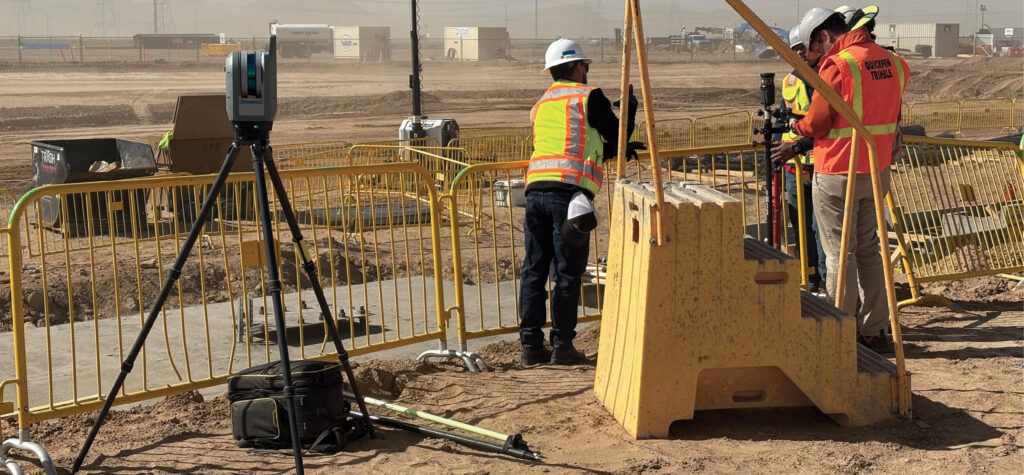
These trends influence how data centers are designed and built. Projects are characterized by dense infrastructure, complex routing of utilities and rigorous quality requirements. In this build context, field measurement and verification must remain both precise and rapid. Construction teams increasingly use 3D laser scanning to meet these requirements.
Tolerances in tight spaces
Modern data centers integrate structural systems, electrical distribution, mechanical plant, cooling equipment and IT racks in highly coordinated assemblies. Each of these components occupies defined spatial envelopes, and small misalignments can create conflicts that complicate installation.
In projects with strict tolerances, traditional measurement techniques can be slow and prone to human error. 3D laser scanning captures millions of points across a site or structure with high resolution. These point clouds provide an exact digital record of existing conditions that can be reviewed in a model-based environment.
By integrating scan data into building information models (BIM), teams can perform detailed comparisons between designed geometry and as-built conditions. This enables identification of discrepancies early, when corrections are still feasible and far less costly than changes made after downstream work has begun.
Accurate reality capture also enables prefabrication of electrical and mechanical assemblies. Scanning structural elements before production ensures that components will fit when delivered, reducing the risk of delays due to mismatches between field conditions and fabricated assemblies.
Coordinated construction in the cloud
A key driver of scanning adoption is its ability to support digital delivery. When teams feed point-cloud data into a common data environment, project stakeholders work from one verified reference that aligns design, fabrication, installation and quality control. In data center projects, this connected workflow is important because trades often operate concurrently. By anchoring design models to current field conditions, teams reduce the likelihood of conflicts emerging during installation, which gives them the confidence to make real-time decisions.
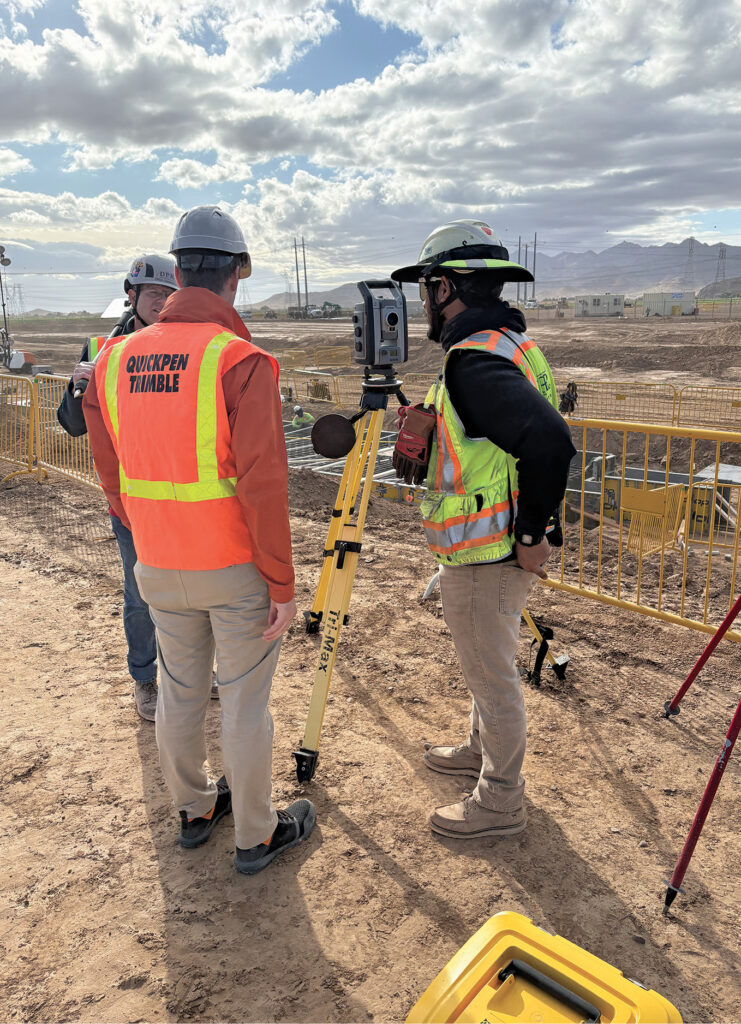
Scanning also improves subcontractor coordination. Trade partners can all access the same high-fidelity data to plan their work. By clarifying responsibilities between disciplines, they maintain quality and avoid schedule disruptions.
Fast-track facilities
Data center construction schedules are typically aggressive. Owners and operators plan facility operations to meet business commitments or service rollouts. Delayed openings can have significant financial implications. Often, schedules allow little room for remedial work once systems are installed.
In this context, reality capture serves as a verification tool. Scans performed at specific milestones, such as after structural completion or before mechanical system installation, provide data that confirms whether dimensional criteria have been met. If conditions fall outside acceptable limits, teams can adjust before additional trades mobilize. The proactive use of scanning helps reduce unplanned work and accelerates the pace of modern builds.
Remote inspections for reduced risk
Scanning accelerates field verification by reducing the need for repeated manual measurements. When construction zones become congested with installed systems, accessing specific points for spot checks can be hazardous and slow. Laser scanning captures data remotely, allowing technicians to remain at safe distances.
Captured data also allows for virtual inspections by off-site team members, which reduces travel time and helps field and office teams stay in agreement without repeated in-person sessions. Less time spent on manual measurement tasks increases overall on-site productivity.
Scan data supports systemwide improvement
While reality capture provides a foundation of accurate spatial data, its value increases when integrated with broader construction practices. For example, linking laser scans to layout tools, quality assurance systems and manufacturing workflows creates a seamless chain of information that reinforces accuracy throughout the project lifecycle. Prefabrication and modular construction also benefit from scan-based validation. By verifying site conditions prior to building, teams reduce assumptions and align offsite work with what is physically present. Pre-planning helps ensure that modular assemblies integrate smoothly with field-built elements. In addition, scanning strengthens quality assurance and acceptance processes by documenting conditions to a level of detail that can be reviewed and archived. This documentation can be part of contractual quality management processes and help resolve disputes about dimensions or installation errors.
Digital documentation that lasts
Accurate as-built documentation is valuable beyond construction. Facilities that support digital services are frequently upgraded, reconfigured or expanded. A detailed 3D record of installed systems provides owners and operators with a reference for future modifications, maintenance planning and lifecycle management. When scan data is integrated with BIM, it creates a baseline that can be updated over time. This evolving digital representation leads to more efficient planning for changes, reducing downtime and risk associated with future work in highly engineered environments.
Demand drivers and data center expansion
The scale of data center construction underscores the pressures facing design and delivery teams. In addition to the financial growth of the market, demand for capacity continues to rise. Analysts estimate that global demand for data center capacity could increase nearly threefold by 2030 (McKinsey & Company), driven by hyperscale cloud and artificial intelligence workloads. This growth translates into faster delivery timelines, made possible by repeatable standard building blocks and parallel construction rather than sequential. Industry observers note that project durations are tightening, with some large data center builds planned for completion in 12 to 14 months from groundbreaking. Rapid completion requires both verified field information and efficient collaboration among stakeholders, functions that reality capture technologies support directly.
As facilities continue to expand in size, manual progress tracking becomes impossible. The real power of 3D scan data is that it turns a massive, constantly changing jobsite into a continuously updated digital environment. One striking example of this new scale is Meta’s Louisiana data center project. Designed to span 2250 acres with 4 million square feet of facilities and multi-gigawatt compute capacity, it highlights just how critical digital measurement has become.
Scanning as the standard
Data center construction presents a convergence of tight tolerances, dense infrastructure and compressed schedules that are distinct from many other building types. In this context, 3D laser scanning has become an essential tool for providing reliable, high-resolution field measurements that represent site conditions. Integrating that data into digital models helps teams match field work with design intent and allows efficient prefabrication, coordination among trades and field verification.
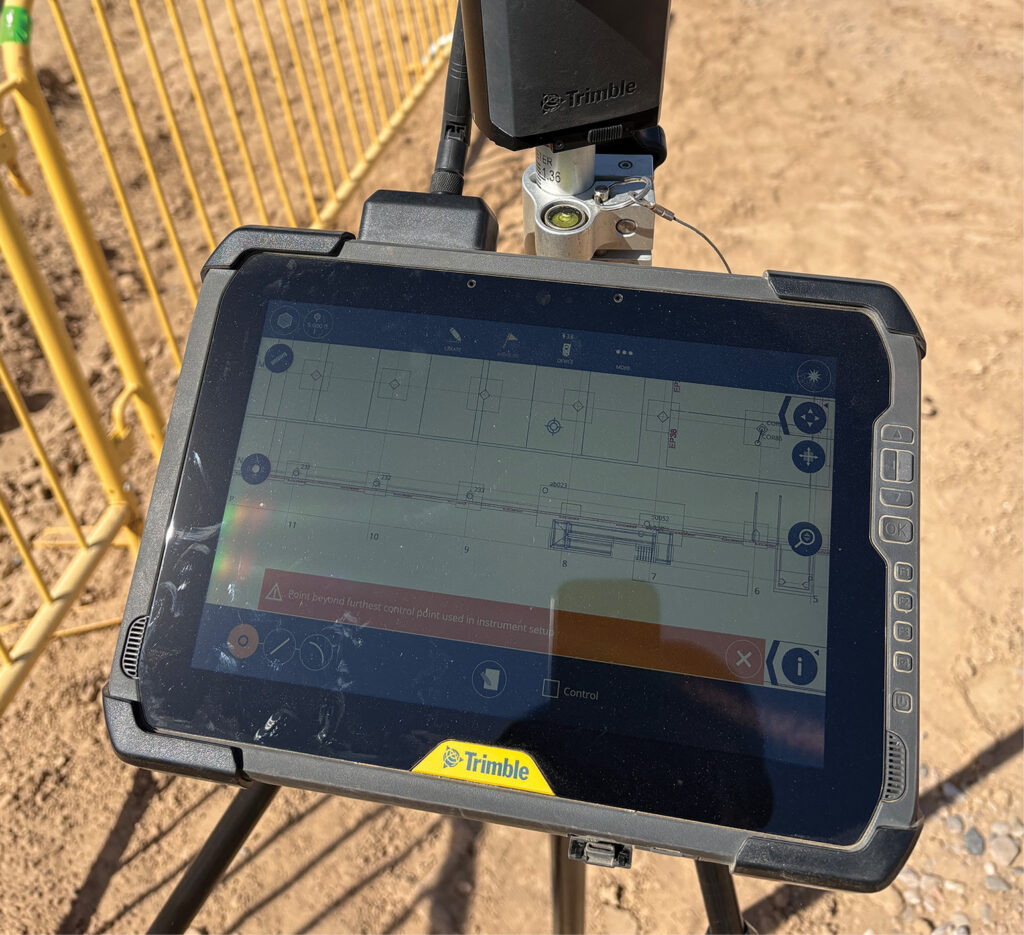
As demand for data center capacity continues to grow and project timelines remain constrained, reality capture activities support construction that meets both performance and schedule requirements. The industry’s shift toward connected digital workflows reflects the need for reliable information at every stage of delivery, and laser scanning provides a scalable method in technically complex environments.