For energy providers, transformer substations are an integral component of the energy grid, securely and reliably transmitting electricity to homes, businesses, schools, hospitals, etc., at the correct voltage.

Detection of persons with HxGN dC3 LidarVision.
Major incidents involving substations are rare. When a situation arises, however, it can cause significant problems, as was highlighted in early 2025 when a fire at a site in the UK interrupted power to 5000 homes and affected a large international airport.
Such threats, combined with the increasing demand for electricity, have authorities focusing more attention on protecting critical infrastructure.
New regulations such as the Critical Entities Resilience (CER) Directive, which will come into force across all European Union Member States in July 2026, and Germany’s KRITIS Umbrella Act are being introduced to guide organizations responsible for national critical infrastructure in ensuring their resilience in the face of existing and emerging threats.
Until recently, the best practice for safeguarding unmanned substations focused on traditional forms of perimeter protection, such as fencing (typically steel, with passive infrared sensors), alarms, remote monitoring via CCTV cameras, and an access control system (often operated via a card or biometrics to manage authorized entrance).
These traditional solutions, nonetheless, have limitations. Two-dimensional cameras are less effective in poor lighting and cannot identify or track intruders once they’ve penetrated a perimeter.
That’s where 3D volumetric detection using lidar (light, detection and ranging) technology surpasses traditional security measures.
Pilot lidar project
EG.D, part of the E.ON group, supplies electricity to 2.7 million people in the southern regions of the Czech Republic, on the borders with Austria and Germany. The company operates and maintains infrastructure, including power lines and high-voltage transformer substations.
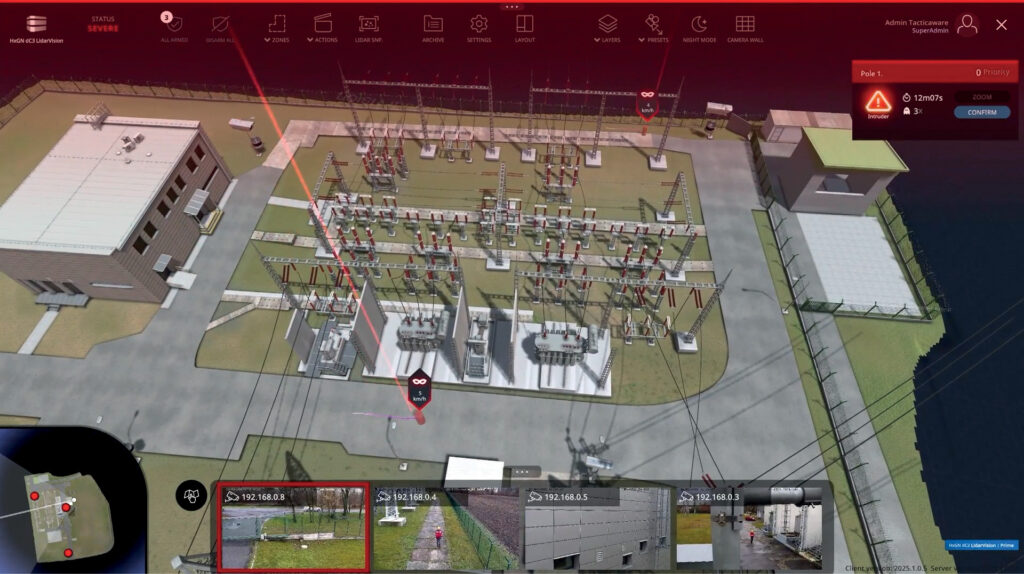
Hexagon’s HxGN dC3 LidarVision in a power substation application.
With so much critical infrastructure at stake, EG.D decided to embark on a pioneering pilot project that would test the very latest in lidar-based 3D surveillance technology in securing substations and power lines.
HxGN dC3 LidarVision, part of Hexagon’s dC3 physical security portfolio, was the solution chosen for the project. This advanced 3D surveillance software solution is based on volumetric detection technology and is designed to secure entire sites, unlike traditional perimeter protection systems, which tend to concentrate only on the fence line.
“We wanted to assess how the technology could be used to provide stronger security to keep unauthorized people out of substations, locate intruders and improve safeguards for maintenance personnel while they are working on-site near high-voltage equipment,” said Tomáš Sofka, head of security technologies at EG.D.
Secure zones
The project uses five strategically placed lidar sensors that enable the virtual creation of secure, safe and sterile zones (including the perimeter fence). These zones can be switched on and off or changed at the click of a button or drag of a mouse. For example, when maintenance is being carried out, the zone in which the work is taking place can be deactivated. Meanwhile, other areas remain live to prevent workers from straying into an unauthorized or potentially hazardous area.
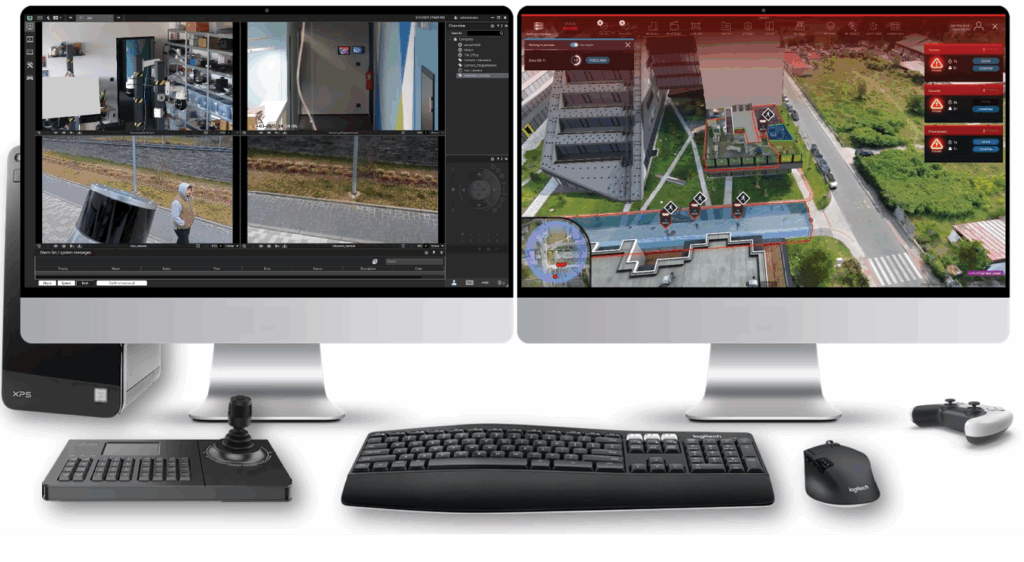
Console for HxGN dC3 LidarVision.
Authorized personnel and trespassers can also be automatically monitored and tracked via a live, real-time feed into EG.D’s security control room. Furthermore, the system recognizes the number of people and their precise positions, along with their speeds and directions of movement (if walking or running) and even their projected trajectories. This can be augmented further with PTZ (pan, tilt, zoom) cameras, alarms and speaker systems to communicate with the person(s) in question.
Digital twin advantage
Another significant advantage of this type of system is the ability to create a digital twin for every substation. In doing so, scenarios can be played out virtually to test the resistance and resilience of safety and security measures. Essentially, this process creates a 3D representation/map of the entire facility with which users can interact. It enables the positioning of lidar sensors and cameras to be optimized to mitigate potential blind spots or poor viewing angles before anyone steps on site.
The system can be enhanced further using thermal sensors and cameras that monitor the temperature of designated areas and raise an alert if it deviates from the norm. This is valuable for intrusion detection and the early detection of fire, before it begins to smoke or ignite.
Global need
In March, the International Energy Agency (IEA) reported that global electricity consumption surged by 4.3% in 2024, driven by a wide range of factors, with increasing demand both in the home and across industry. Greater reliance on energy makes it more of a target, highlighting why critical pieces of infrastructure need to be afforded the highest level of protection.
As a result of the pilot’s success, EG.D and Hexagon are working together on a plan to roll out HxGN dC3 LidarVision to other energy facilities across EG.D’s grid. The company is also actively sharing its knowledge with other national energy companies, including those in the U.S. and Asia-Pacific regions, which are considering this new approach for substation resilience, safety and security.
The success of EG.D’s pilot project demonstrates the transformative potential of lidar-based 3D surveillance in safeguarding critical energy infrastructure. By enhancing perimeter security, enabling real-time tracking, and leveraging digital twin technology to optimize safety measures, this innovative approach is paving the way for a more resilient and secure energy grid.
 Martin Vojtek has over 20 years of experience in security and IT. Most notably, he helped to found Tacticaware, a company known for developing Accur8vision, a lidar-based 3D surveillance solution, before it was acquired by Hexagon in 2020. He serves as Business Director for 3D Surveillance at Hexagon’s Safety, Infrastructure & Geospatial division.