It Is Your Game
Simon W. Musaeus
- Independently published, Las Vegas, Nevada, 2025
- 225 x 151 mm, xi + 201 pp, 31 color diagrams and numerous tables
- Paperback, ISBN 979-8-280-06908-4, $32.99 from Amazon in US.
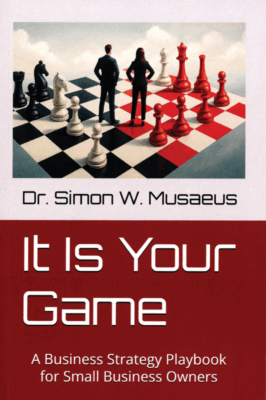
Is felicity with the pen a characteristic of geospatial folk? We can imagine colonial survey officers scribbling erudite reports in their tents 70 years ago, or brilliant professors drafting papers today for journals with more peer-review rigor than ever. Shortly after reviewing David Maune’s 25¢ Piano Lessons, I find myself assessing It Is Your Game by Dr. Simon W. Musaeus, marketed as “a business strategy playbook for small business owners.”1
I have known Simon Musaeus for a number of years. We met first at NV5’s “Acquisition Summit 4.0” customer meeting in Corvallis, Oregon, in 2019. Failure to remember names is a big weakness of mine and so it was in Musaeus’s case: I tersely recorded in my meeting notes, “Remember COWI guy. DBA.” I did follow up, partly because a DBA is uncommon, especially in the geospatial world. After a glittering career in the German artillery, Musaeus rose to senior vice president mapping and geoservices at COWI, a big geospatial services company near Copenhagen, Denmark, which I had visited back in my Leica days around the turn of the century. COWI’s aerial survey assets were acquired in 2020 by Hexagon, where Musaeus became vice president, Geospatial Content Solutions, steward of the firm’s new geospatial content program. We kept in touch, however, and, fortuitously, Musaeus made his home for part of the year near San Diego so we were able to meet, to talk about geospatial trends and personalia, over sublime West Coast IPAs. During this period, furthermore, Musaeus was co-founder and president of the European Association of Aerial Surveying Industries (EAASI),2 an organization set up in 2019 to represent the interests of firms using crewed aircraft for aerial survey. Tempus fugit, though, and Simon has moved, from America to Europe all year round and from Hexagon to consultancy. This book reflects the latter.
After a short introduction, Musaeus divides the content into five pillars, though, given his recent employment history, we may have expected six. Indeed, he omits pillar 5 from his explanation of the structure of the book. Pillar 1 is “Exploration and inventory: finding out where you are,” with seven recognized techniques for this first part of the process. Each technique is described very briefly, followed by advice on how to approach it (down to the smart whiteboard). Importantly, the author assesses each technique in terms of time intensity and complexity, as well as giving advantages, disadvantages, dos and don’ts.
Pillar 2 is “Drawing the roadmap: building your company’s strategy, ” has nine tools and Pillar 3, “Making it work — executing the strategy,” 14 tools.
Pillar 4, “Team dynamics and decision making – success comes in groups of …,” is not part of the sequence formed by the other pillars, but contains crucial information if strategies are to be created then successfully executed. The focus is on forming and leading a successful team, based on the Myers-Briggs Type Indicator (MBTI) personality assessment tool. The pillar is divided into three steps: the first explains MBTI in greater depth and describes how to use it for team-building; the second introduces tools that foment productive discussion while taking into account the differences between the team members; the third suggests how to resolve biases and other inconveniences. I was pleased to see the Abilene paradox get an airing here, remembering it from one of my own management training experiences.
The book ends with Pillar 5, “Your brace: an ultimate fast track for the desperate owner.” Musaeus admits that it is a little anomalous — does it belong at the end or the beginning? The chapter addresses the leader who has “no time for anything.” It seeks to provide help to go beyond panic and inactivity to useful progress. Musaeus’s description of the slough of despond is captivating. The “rapid response toolkit” offers five tools, followed by a paragraph about balancing speed and strategy. Thus the book ends strongly by becoming significantly more applicable.
The book is intense: containing numerous short summaries of established techniques, it requires concentration and is best read a few pages at a time. Most of the techniques are widely available in business textbooks, but Musaeus collects a remarkable number in a manageably short volume. Initialisms are commonplace and at one point I thought the book was talking about subject-matter experts (SMEs), when the text reminded me – small- and medium-sized enterprises!
There are two appendices. The first is about setting up meetings, an unpleasant chore for many of us and doubtless returning to the fore as attendance at the office becomes increasingly mandatory. The second is about intellectual property — detailed acknowledgements of the author’s sources and hints on using the tools.
There is no doubt about the intelligence and competence of the author. Moreover, as one would expect from a DBA, he is well read and provides a useful bibliography, wisely restricted to 27 items, many of them much cited, such as Porter’s 1979 paper on competitive forces3.
It’s interesting that Musaeus gives fulsome acknowledgement to several close acquaintances, several of whom are involved in EAASI. One of them is Rachel Tidmarsh, treasurer of EAASI and CEO of the UK geospatial services company Bluesky. Her company must have followed a successful strategy: it was attractive enough to be acquired by Woolpert earlier this year!
The book, therefore, is wide-ranging and packs an enormous amount of advice into a small space. There are useful hints on what to do and what to avoid with respect to each technique, as well as the time requirements and complexity of each. For example, Musaeus describes how each tool can be used rapidly by the CEO and one or two senior managers, or, if more time is available, in a larger charette. Thus he goes beyond summaries that make established approaches more accessible, through assessment of their practical implementation and value. Furthermore, he often makes suggestions as to which tool(s) to use before and after the one under discussion. Even more useful are his “Great Tip” boxes, which are used to give advice that one suspects comes straight from his own experience.
Having participated in numerous strategy meetings and workshops, I wish I had had Museaus at my side to provide guidance. He knows multiple tools intimately, whereas in my experience we often had only one, which the meeting leader assured us was the greatest thing since sliced bread. That’s not the case here. On the other hand, while we often had good data on our own sales, for example geography, market segment and price points, we had rather less on our competitors, though we did have detailed technical comparisons of our products against theirs. Nevertheless, I worry that Musaeus assumes that SMEs have more hard data at their fingertips than they really do. How many of the tools work without it? Sensitivity analysis, for example, is vulnerable to poor data. Musaeus often warns against using the tools with only assumptions, but in practice there may not be anything better. Strategizing is tough!
For this reviewer, however, and, I surmise, many readers, the book begs for case studies, or at least examples of the application, success or failure of techniques in practice. Hexagon is much too big to be a candidate, as is the German military, but Musaeus has enormous experience of customers of all sizes and has discussed with them their pain points. Indeed, EAASI’s very focus is the amelioration thereof. Surely he can compose some short case studies of strategic decisions made by small- and medium-sized geospatial firms? How did they reach their strategies and did they succeed? This book is well worth having, but we are gasping for a sequel to It Is Your Game.
1 Another recent contribution is Mark E. Meade’s The Bourbon Journey, published in 2024, but the contents are out-of-scope for a review in LIDAR Magazine.
2 https://www.eaasi.eu/
3 Porter, M.E., 1979. How competitive forces shape strategy, Harvard Business Review, 57(2): 137-145.